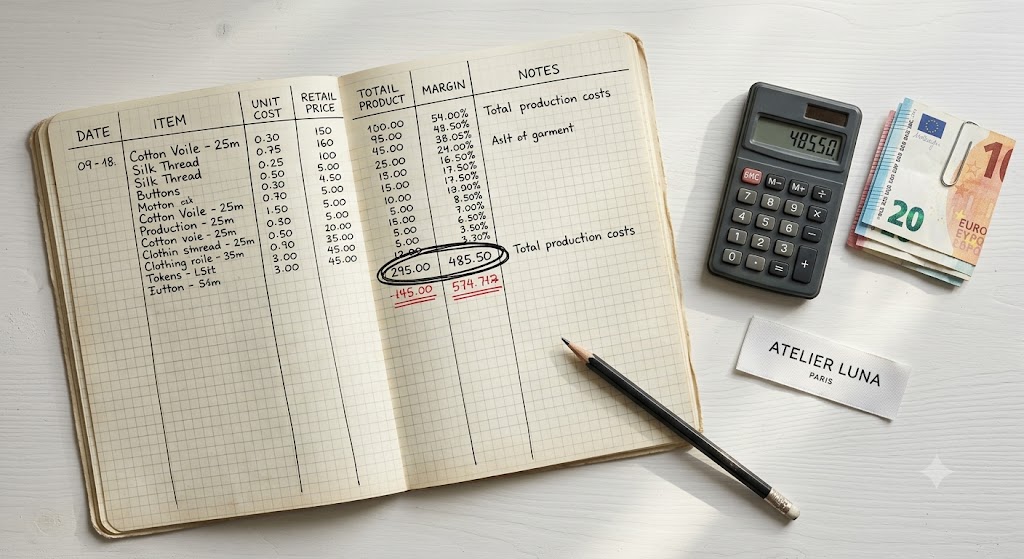
Pricing a first collection is where most emerging brands make the decision that will haunt them for two years. They guess at a number that feels right, check it against competitors, and call it done. Then they wonder why they are running out of cash after the first order. Here is the math, done plainly.
The four numbers
You need: Cost of Goods (COG), your target wholesale margin, your target retail margin, and your actual unit volume at each price point. Everything else is a story you tell yourself.
COG is the fully-loaded cost to produce one unit, landed in your warehouse. It includes: fabric cost, CMT (cut, make, trim), all trims and labels, packaging, shipping from factory, duties and taxes, and a quality control allowance. Do not include your time, your samples, or your marketing budget in COG — those are overhead, not product cost.
The margin math
Wholesale margin = (Wholesale price − COG) / Wholesale price. A 50% wholesale margin is a starting minimum for a brand that wants to survive. At 50%, if your COG is €18, your wholesale price is €36. Below 50%, you are not generating enough margin to cover your overhead and growth costs.
Retail margin = (Retail price − Wholesale price) / Retail price. Standard retail keystone is a 2.5–3× wholesale multiple: if your wholesale is €36, retail lands at €90–108. Direct-to-consumer eliminates the retailer's margin, so your DTC price can be lower while still generating more margin per unit.
A worked example
For a mid-weight cotton crew-neck sweatshirt made in Portugal, a realistic COG breakdown might look like this:
| Fabric (per unit at MOQ) | € 9 |
| CMT | € 7 |
| Trims and labels | € 2 |
| Packaging | € 1 |
| Freight and import duties | € 2 |
| QC allowance | € 1 |
| COG LANDED | € 22 |
| Wholesale price (50% margin) | € 44 |
| Retail price (2.5× wholesale) | € 110 |
At €110 retail the unit margin is €22 — the same as the COG. That margin needs to cover studio rent, website costs, photography, and every other overhead line before you reach profit. At 300 units sold, the total gross margin is €6,600. Whether that is enough depends on your fixed costs. Put those in the spreadsheet too.
When the math doesn't work
If the spreadsheet produces a retail price that is too high for your target market, there are three levers — and only three. Lower the COG by simplifying the construction, reducing fabric waste, or increasing order volume to get a better unit price from the factory. Simplify the product by removing trims, switching to a standard hem finish, or cutting a style that uses less fabric. Or accept a lower margin on this style and compensate with better-margin items elsewhere in the range.
A fourth option — raising the retail price above what the market will pay — is not a lever. It is a wish. Build the spreadsheet. Put in real numbers. If the result is uncomfortable, better to know it now than to discover it after your first production run lands.
The number nobody talks about
The honest question is not "what price maximises margin per unit?" It is "what price generates enough total margin to cover all my fixed costs?" If your overhead is €5,000 per month and your unit margin is €22, you need to sell 228 units per month to break even. Is that achievable at your target price? If not, the math does not work — and no amount of brand storytelling will fix it.