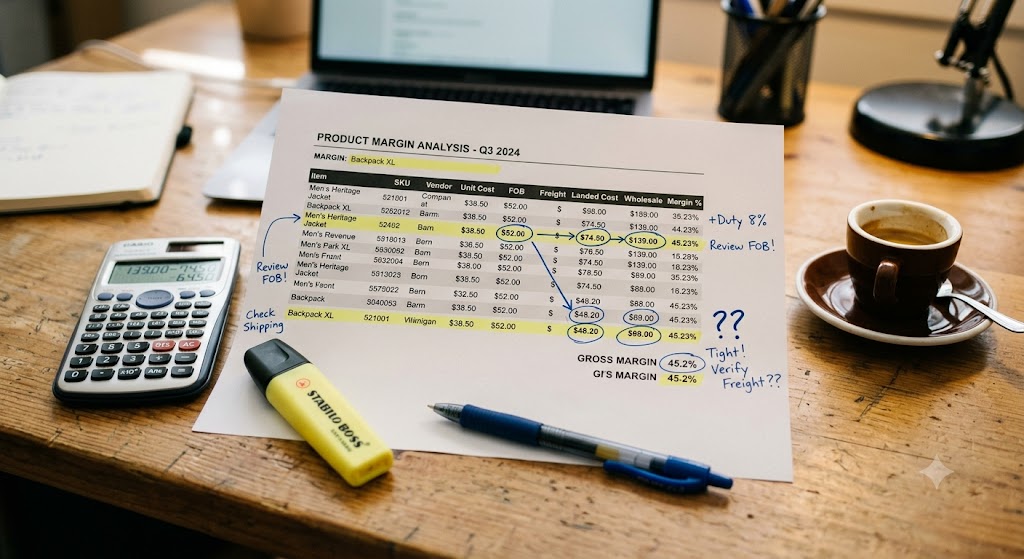
A cost sheet is a column of numbers. The skill is reading it as a story about margin — where it lives, where it disappears, and whether the final retail price makes sense for the market.
FOB: the factory's number
FOB (Free On Board) is the price the factory charges to deliver finished goods to the port of export. It includes fabric, CMT, trims, labels, packaging, and the factory's margin. It does not include shipping, insurance, duties, or any cost that occurs after the goods leave the factory. For a mid-weight cotton sweatshirt made in Portugal in 2025, FOB typically runs €12–22 depending on construction complexity and order volume.
Landed cost: what you actually pay
Landed cost = FOB + freight + insurance + import duties + customs clearance fees + delivery to your warehouse. For EU-to-EU production there are no import duties and lower freight, but for Asia-sourced goods the duties can add 10–20% to the FOB price. Add a quality control allowance and landed cost typically lands at 120–135% of FOB, though the real number moves with shipping method (air vs. sea), the trade lane's duty rates, product category, and which Incoterm you actually agreed to beyond FOB (CIF and DDP shift these costs onto the factory side of the equation).
The wholesale margin calculation
Wholesale margin = (Wholesale price − Landed cost) / Wholesale price. A 50% margin means your wholesale price is twice your landed cost. For most emerging wholesale brands, that is a practical minimum for sustainability, not a universal law — premium and luxury labels, DTC-heavy brands, and businesses built on strong reorders can sometimes run leaner. But if you are pricing a standard wholesale line, treat 50% as the number to defend. Many emerging brands price to 40–45% margin thinking it is close enough. It usually is not — the gap between 45% and 50% is the gap between barely surviving and having runway to grow. And wholesale margin is not net profit: it still has to cover operations, marketing, returns, and overhead before anything is left over.
Retail and DTC
A common wholesale-to-retail markup is 2.5–3×, though luxury positioning often runs 3.5–5× and DTC-hybrid brands sometimes retail at a lower multiplier since they are not splitting margin with a wholesale partner. At 2.5×, a €24 wholesale price becomes a €60 retail price. Work backwards from the retail price you want and check that the numbers hold. If they do not, the first lever should usually be cost or design — reduce the COG or simplify the construction — since the retail price itself is what determines your market positioning. Changing it to force the math to work should be the last thing you touch, not the first.
A worked example
Take a sweatshirt at FOB €18. Landed cost at 122% of FOB comes to about €22. Priced at a 50% wholesale margin, that puts wholesale at €44, and at a 2.5× retail markup, €110 at retail. Now move FOB up to €20 without changing anything else: landed cost rises to roughly €24.40, and holding the same €44 wholesale price drops your margin to about 45% — the exact gap the margin section warns about. A €2 swing in FOB, unnoticed, is enough to erode the runway the 50% threshold was protecting.