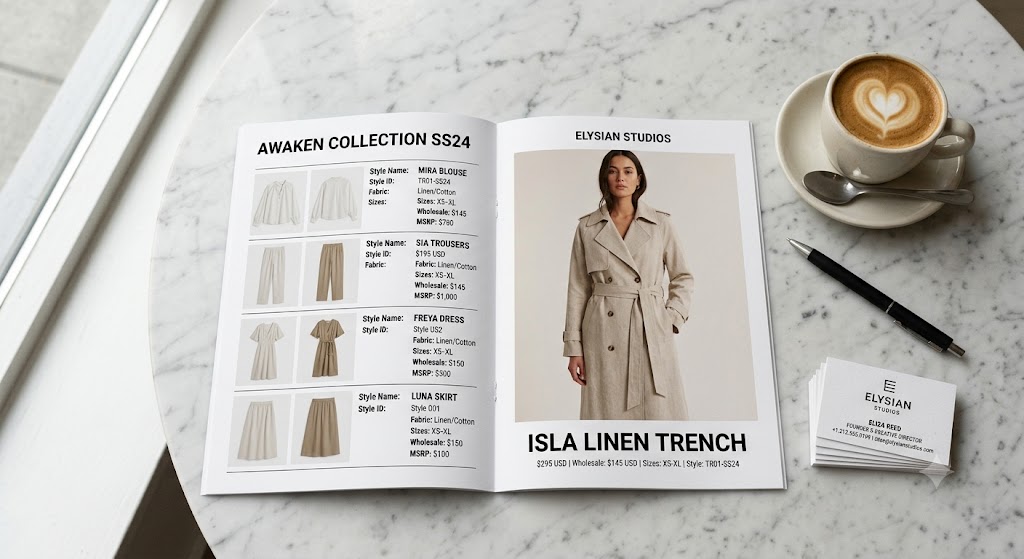
Buyers often decide whether to keep reading a linesheet within the first few pages. Before they have handled your garments or spoken to your team, the document has already shaped their impression of your brand. Most brands treat the linesheet as an afterthought — something assembled in a hurry from product photos and price lists the week before a trade show. A well-structured linesheet communicates that you understand wholesale, and understanding wholesale is the first thing a buyer is evaluating when they flip through your pages.
The hierarchy buyers expect
Buyers do not read linesheets front to back — they scan for the information that reduces uncertainty. A buyer looking at a linesheet is answering four questions in order: Does this brand fit my store's identity? Does the product make commercial sense? What are the terms? What do I need to order? Every page should answer the next question they are likely to have, in that order.
Start with one page of brand context — who you are making for, what the season's direction is, one strong image. Do not use this page to tell the story of your founder. Use it to make the commercial case for why your product belongs in their store.
Product pages
Each product page needs: a clean product photo, style name and number, available colourways with accurate colour representation, wholesale price, and suggested retail price. Delivery window and order deadline belong on every page — not just on the terms page at the back. Buyers are managing cash flow and floor space; they need to see when it arrives before they decide whether to buy. Every product page should also follow the same layout — consistent spacing, typography, and image scale. Buyers compare products quickly, and a consistent page lets them focus on the garments instead of decoding the page.
Compare two ways of presenting the same style:
Oversized overshirt
versus
Style 214 — Oversized overshirt. Three colourways. Wholesale €85, suggested retail €210. Delivery February 2027. MOQ 12 units.
The second version lets a buyer make a decision immediately, without a follow-up email.
The hero SKU
Lead with your strongest piece, in most cases. The first product in your linesheet sets the tone for everything that follows. If your opening piece is a background basic at an uninteresting price point, you risk losing the buyer's attention before they reach the pieces that would have won them over. Put your most distinctive, commercially viable piece first — unless your collection is intentionally organised by story, category, or delivery drop, in which case let that logic lead instead.
The terms page
Every linesheet needs a terms page — usually the last page, sometimes the second. It should state: minimum order quantity per style, minimum order quantity per colour within a style, order deadline for the delivery window, delivery window as a specific month and year (not a vague "Spring"), payment terms (net 30, 50% deposit, etc.), and your cancellation or returns policy. Missing commercial information creates unnecessary friction. Some buyers will ask for clarification, but many — especially when reviewing dozens of brands in a season — will simply move on to the next one. If you are not yet ready to commit to all of these, state the terms you have and mark the rest as "available on request."
Format and delivery
Send a PDF. A PDF preserves your layout, typography, and pagination across devices, which makes it easier for buyers to annotate, print, archive, and circulate internally — design it to stay readable on both an A4 printout and a laptop screen. Linesheets sent as image files, Google Slides, or Canva links look unfinished by comparison and are harder for buyers to forward to their buying team. Name the file with your brand name and season: Brand_SS27_Linesheet.pdf. A clean, consistent filename looks more professional and avoids confusion when buyers are comparing dozens of collections at once — a stray "final" or "v3" won't sink a good collection, but it is one small tell worth removing. Keep it to one version per season, updated in place.
A good linesheet is not a catalogue. It is a sales argument in document form. Treat it that way.