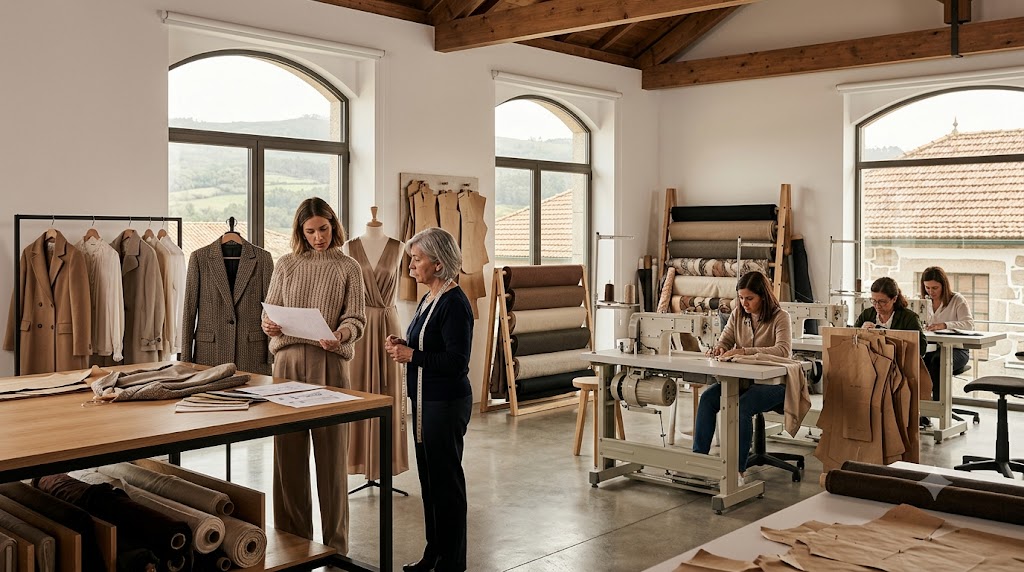
Portugal has become the shorthand answer for European production among small and emerging brands. It offers lower MOQs than most EU countries, reasonable lead times, Made-in-Portugal credentials, and a manufacturing cluster that has been working with international brands for decades. But the decision of where to make is more complex than the Instagram consensus suggests.
Lisbon vs Porto
Most of Portugal's garment manufacturing capacity sits in the north — in and around Porto, Braga, and the Ave Valley. Lisbon has showrooms, agents, and brand headquarters, but fewer active factories. If you are sourcing directly, plan to work north of Lisbon.
| LISBON | PORTO / NORTH | |
|---|---|---|
| MANUFACTURING DENSITY | Low | High |
| ACTIVE FACTORIES | Limited | Many |
| AGENTS / SHOWROOMS | Strong | Moderate |
| SAMPLING ACCESS | Depends on network | Strong |
| BEST FOR | Brand meetings, sourcing visits | Development and production |
The advantage of the Porto cluster is density: within 50 km you will find cut-and-sew factories, fabric mills, trim suppliers, and washing facilities. Sampling, revisions, and production can all happen within a short radius, which compresses your development timeline.
What MOQs actually look like
Portugal's reputation for low MOQs is partly true and partly a sales pitch. For basic jersey items at established factories, realistic MOQs in 2026 run 100–200 units per colour per style for a first order, with some factories going down to 50 for brands with a clear growth story. For wovens or anything with complex construction, expect 200–500 minimum.
Factories that advertise 30-unit MOQs are either charging a significant premium per unit or taking on very small orders to fill capacity gaps. A 30-unit order at premium pricing may cost more per unit than an Asian factory at 300 units, even accounting for shipping and duties.
Portugal is strongest for
Cut-and-sew jersey, knitwear, premium casualwear, and lightweight outerwear are where Portuguese factories have the most experience and competitive pricing. For highly technical garments, performance fabrics, or very low-cost basics, the calculus changes — and you may be paying for a "Made in Portugal" label on a product that does not benefit from it.
EU vs Asia in 2026
The honest comparison: Asian production remains significantly cheaper on a per-unit basis, even after shipping, duties, and import taxes. But "Asia" is not one market — China, Vietnam, Bangladesh, India, and Turkey each have different strengths in cost, expertise, MOQ, and communication cadence. EU production wins on flexibility (faster revisions, smaller minimums, easier quality oversight), sustainability storytelling, and lead time proximity.
The decision is not purely financial. Where you make is part of your brand identity.
Choose Portugal if
- You are producing 100–1,000 units and expect several sample rounds
- Fit and construction quality are critical and you want to be close to the factory
- Your customers value European manufacturing as part of the product proposition
- You need the flexibility to revise quickly between samples
Choose Asia if
- Your product is already proven and specifications are stable
- You need volumes above 1,000 units per style and cost per unit is the main driver
- You can manage longer lead times and less frequent in-person oversight
The question is not whether Portugal or Asia is better. The question is whether your product, volume, timeline, and brand promise match the strengths of the region you choose. Be honest about which market position you are in before you book your flight to Porto.