The conventional wisdom is that you should visit a factory before you place an order. It is good advice. It is also impractical for most early-stage brands with limited budgets, especially when the factory is in another country. Here is how to vet a factory remotely without compromising your due diligence.
What to ask in the first conversation
Ask for: their MOQ by garment category, their current lead time for sampling and production, examples of comparable products they have made or references they are authorised to share, their capacity (units per month, number of machines, number of workers), their quality control process, and their communication process — who your point of contact will be, how often they send updates, what happens when there is a problem. Many factories cannot hand over a client list — luxury, private-label, and OEM work is often covered by NDA — so asking for comparable work or authorised references gets you further than asking for names they are not free to give.
While they answer, pay attention to how they answer, not just what they say — response time, clarity, and whether they document what was agreed often predict how the relationship will go better than factory size does. Look for explanations that are specific and internally consistent rather than a single precise number: lead times and MOQs genuinely fluctuate with fabric, season, and order size, so a factory that can explain why they vary is showing more competence than one that just states a figure. A factory that hedges everything, or asks you to trust them rather than verify anything, is a different data point than one giving reasoned ranges.
What to look at remotely
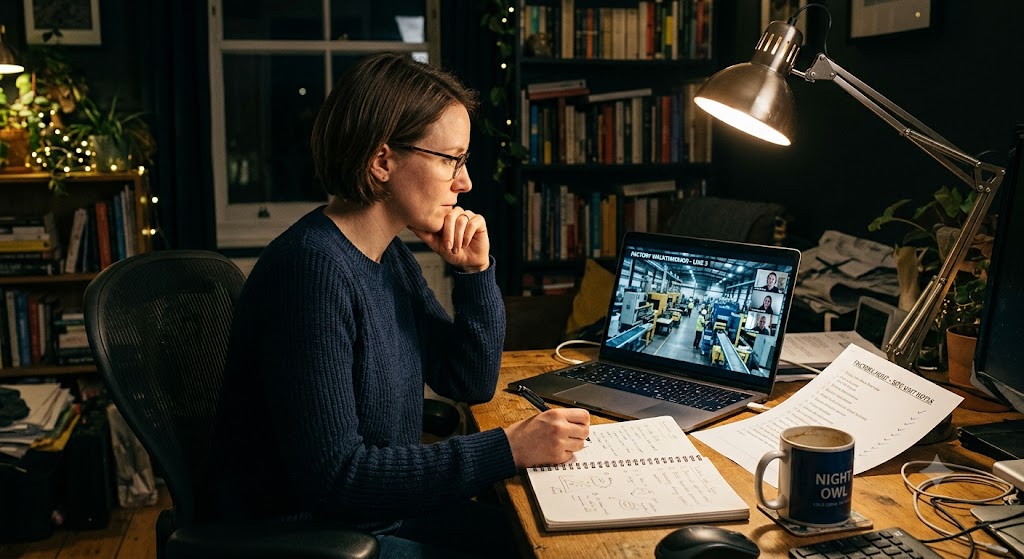
Ask for a factory video walkthrough. A 3–5 minute phone video walking through the cutting room, the sewing lines, and the finishing and QC area tells you more than a thousand words. Good lighting at the sewing stations, organised material flow, and clearly separated cutting, sewing, finishing, and QC areas are all signs of a factory that takes production control seriously — an accurate sense of scale tells you whether their claimed capacity matches what you are seeing. If a factory won't provide a walkthrough, ask what they can share instead — a refusal isn't automatically a red flag (confidentiality agreements and site policies are common reasons), but a lack of any transparency in its place should prompt further questions.
What should prompt more questions
Treat these less as automatic disqualifiers and more as prompts to dig further: a factory that cannot explain where their materials come from or provide traceability appropriate to your project, that has no quality control documentation, that requires full payment for bulk production before you have approved a sample or agreed terms (full payment for the sample itself is normal), or that pressures you to sign a contract before you have seen a sample. None of these guarantee a bad factory on their own, but stacked together they describe a structural risk worth pricing in.
Consider two factories responding to the same enquiry. Factory A answers every question within five minutes but won't provide samples or references. Factory B takes two days, explains their lead times, sends QC documents, and arranges a video call. Factory B is very likely the lower-risk choice, even if their quote is not the cheapest — speed alone tells you nothing about whether they can actually deliver.
Remote vetting isn't about proving a factory is perfect. It is about gathering enough evidence to justify the next investment — a paid sample — and every conversation should reduce your uncertainty before you commit more time or money.
Before placing a sampling order, you should be able to check off: MOQ discussed, sampling lead time confirmed, QC process explained, video walkthrough received (or a clear explanation of why not), references or comparable work reviewed, and payment terms agreed before any sample is approved.