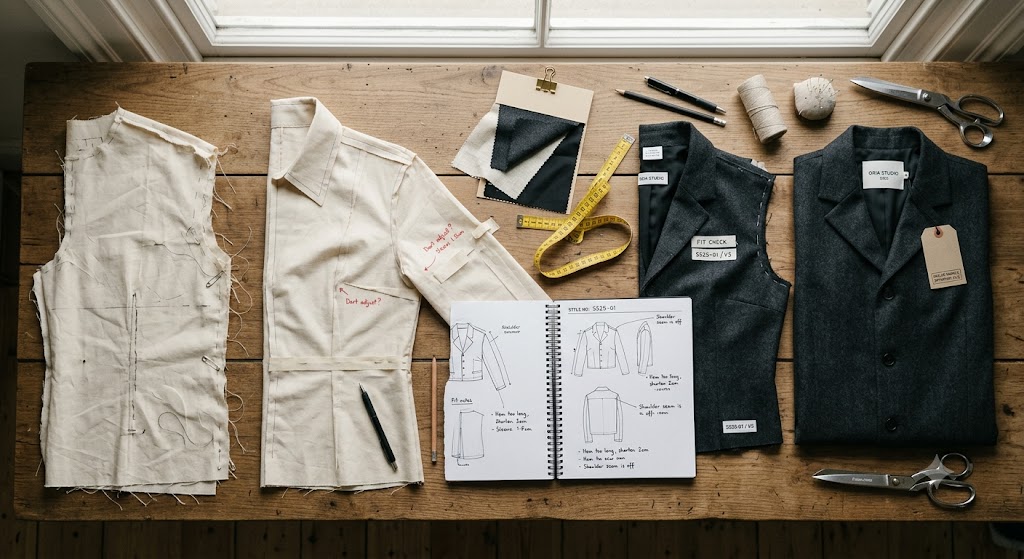
Many emerging brands budget for two sample rounds. In practice, four is often a more realistic expectation for a new style. That gap between expectation and reality is not inefficiency — each round answers a different question, and the answer to one often depends on the answer to the last. Simple carry-over styles with an unchanged block and fabric can sometimes clear in two rounds; a new silhouette, a new factory relationship, or a fabric change will usually need all four. Factories also name these stages differently — proto, prototype, first sample, fit sample, development sample — but the underlying purpose across a new style is broadly the same.
What each round is for
Round one (Proto) is a reality check. Does the factory understand the tech pack? Is the construction method viable? Is the fabric roughly right? Resist the temptation to judge the fit too closely at this stage — construction accuracy and correct interpretation of the tech pack matter more here than precise measurements. Your job at round one is to confirm that the factory is working from the right document and that the construction is in the right territory.
Round two (Fit Sample 1) is the first real fit session. The construction should be correct, the fabric should be close, and you are now evaluating: how does it sit on the body? What needs to move? Generate a clear set of fit comments and send them with a revised tech pack. Do not mix fit comments with construction comments — trying to resolve both in one pass usually slows things down, since changing one variable often affects the other.
Round three (Fit Sample 2) resolves the fit comments from round two. If the factory has executed correctly, this sample should be wearable. You are looking for residual fit issues and confirming the final fabric against the approved swatch.
Round four is the sample made in bulk fabric and trim from the actual production run — sometimes called a sealing sample, sometimes a PPS (pre-production sample) or TOP (top-of-production) sample depending on the factory. This is what you compare the bulk delivery against. For new styles and significant changes, do not skip this round — it is the clearest objective record of what you approved. Repeat production of an unchanged style with a trusted, established supplier is one of the few cases where skipping it is a reasonable risk to take.
On a jacket, for example, the proto might reveal that the collar construction was misread from the tech pack. Fit Sample 1 then corrects shoulder balance and sleeve pitch. Fit Sample 2 confirms those corrections held. The sealing sample verifies that the approved fabric and trims — not just the pattern — perform as expected once they are running through bulk production.
How to log them
Sample rounds only create value if each decision is recorded — otherwise the same problems resurface in the next iteration. Maintain a simple log: round number, date received, tech pack revision used, list of issues found, list of corrections sent, date corrections sent. Add photographs or annotated images of each sample, keep tech pack revisions version-controlled rather than overwritten, and save the dated fit comments and approval emails alongside the log entry. When the bulk delivery arrives, this record is your evidence if there is a dispute about what was approved. Keep physical samples from each round until bulk is received and accepted.