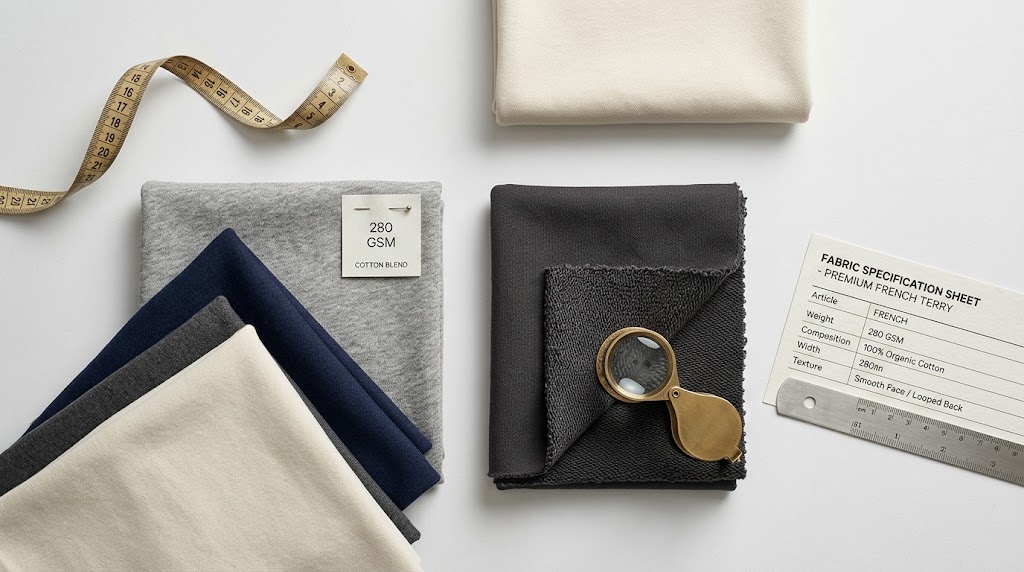
French terry is the workhorse fabric of contemporary casualwear. It is smooth on the outside, looped on the inside, and sits in a comfortable middle ground between a jersey tee and a full fleece. Sourcing it well requires understanding three things: GSM, loop construction, and washing behaviour.
GSM: the number that matters most
GSM (grams per square metre) is the primary spec for any knit fabric. Always confirm GSM on a finished, washed sample — mills often quote pre-wash GSM, which runs 5–10% lighter than the finished garment.
| GSM | TYPICAL USE |
|---|---|
| 220–240 | Lightweight sweatshirts, summer hoodies |
| 240–280 | Standard hoodies, joggers |
| 280–320 | Premium sweatshirts, mid-weight fleece |
| 320+ | Heavyweight streetwear |
Two fabrics with the same GSM can feel completely different. Yarn count, fibre composition, loop density, and finishing all influence softness, drape, warmth, and durability. GSM tells you how heavy the fabric is — not necessarily how it will perform.
The fibre content affects how GSM translates to hand feel. A 280 GSM 100% cotton terry feels quite different from a 280 GSM 85/15 cotton-polyester blend. The blend shrinks less, holds its shape better through washes, and typically pills less at stress points like the armhole and pocket opening.
Loop construction
The loops on the interior of French terry are what trap air and give the fabric its warmth-to-weight ratio. Tight, even loops indicate a well-tensioned knit and consistent GSM across the fabric width. Loose or uneven loops suggest the knit was rushed or the yarn tension was inconsistent — both problems that will show up as distortion after washing.
Measuring shrinkage
Ask your mill for a 50 cm × 50 cm sample and wash it three times at 40°C before you approve it for bulk production. To measure shrinkage accurately, draw a 30 × 30 cm square on the sample before washing. After three wash cycles, measure the square again in both directions — warp (length) and weft (width). Anything above 5% in either direction needs to be factored into your pattern, or you need a different fabric.
What to ask the mill
- Pre-wash and post-wash GSM
- Shrinkage percentage — warp and weft separately
- Fibre composition and yarn count
- Fabric width (160 cm is standard; narrower means more waste in cutting)
- Loop height and loop tightness
- Pilling resistance rating
- Colour fastness rating
- Minimum order quantity (MOQ) per colour
The mills that cannot answer these questions clearly are the mills that will cause you problems at the seam allowance stage. Good terry is easy to spec. The hard part is finding a mill that takes your quantities seriously.
Common sourcing mistakes
- Approving fabric before washing. Pre-wash hand feel is not the hand feel your customer experiences.
- Comparing fabrics by GSM alone. Two fabrics at 280 GSM can perform very differently depending on fibre content and construction.
- Ignoring shrinkage data. Unaccounted shrinkage becomes fit problems after the first wash.
- Forgetting usable fabric width. Selvedge waste, folded edges, and printing margins all reduce the width you can actually cut from.
- Choosing the cheapest mill without requesting test reports. A mill that cannot provide shrinkage and pilling data is not set up for repeat production.