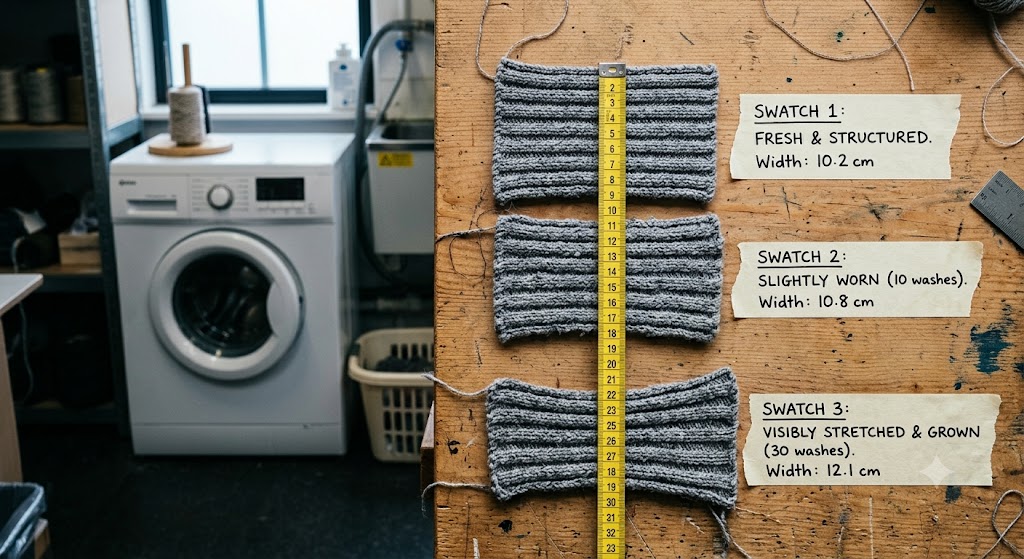
Rib trim — the knitted ribbing used at necklines, cuffs, and waistbands — is the most structurally critical component on most casualwear garments, and the most frequently under-specified. It also moves more in washing and wear than almost any other component.
Why rib moves so much
Rib is a two-way stretch fabric. Its structure — alternating knit and purl columns — creates a fabric that stretches and recovers in the width direction. This recovery property is what makes it useful at openings: it stretches to allow the head or hand through, then snaps back to grip the body. The problem is that elasticity is sensitive to heat, chemistry, and tension. A washing machine subjects the neckband to all three simultaneously, in ways that the garment body typically handles better.
A common failure case: a sweatshirt with correct body fabric but under-spec cuff or neckline trim. After five to ten washes the opening stretches out while the body of the garment stays stable, so the piece starts to look worn even though the fabric itself is still structurally sound.
What to spec
Fibre content: 2–5% elastane is typical for cotton rib, balancing recovery against hand feel, with 3–5% cotton/elastane the most common commercial range in midweight casualwear. Some premium ribs run 100% cotton with a tighter, compact knit instead of elastane, and performance-oriented garments sometimes push elastane higher intentionally — so treat this as a starting range to confirm against your supplier and category, not a fixed spec. As a rough guide, above 5% elastane the rib tends to feel synthetic, and below 2% it is more likely to lose recovery after repeated washing, with the neckband growing and failing to spring back. Finishing also matters as much as fibre content in many cases — compacting, enzyme or pre-washing, and heat setting all affect how stable the rib stays, so two ribs with an identical fibre spec can behave very differently depending on how they were finished.
A common application length is 85–90% of the neckline opening for a crew neck and 90–95% for a V-neck. Under-stretching the trim during application reduces the negative ease built into the seam, which is what lets the neckline gape over time. Over-stretching it increases residual tension in the seam, which shows up as puckering and distortion once the rib relaxes through repeated wash-and-recovery cycles.
The wash test worth running
Before approving rib for production, run three wash cycles at 40°C and measure: the length change, the width change, and the recovery after stretching to full extension. As a general guideline, shrinkage beyond roughly 5% in length is likely to pull the neckline down over time, and recovery dropping below roughly 80% of original width after three washes suggests the trim will lose functional tension in wear — the exact tolerance you can accept still depends on garment design, rib width and gauge, and how forgiving the silhouette is.
Rib is cheap. Testing it is cheaper still. Do not skip this step because it feels like overkill on a small sample order. The washability of your trim determines the lifespan of your garment in the customer's hands.