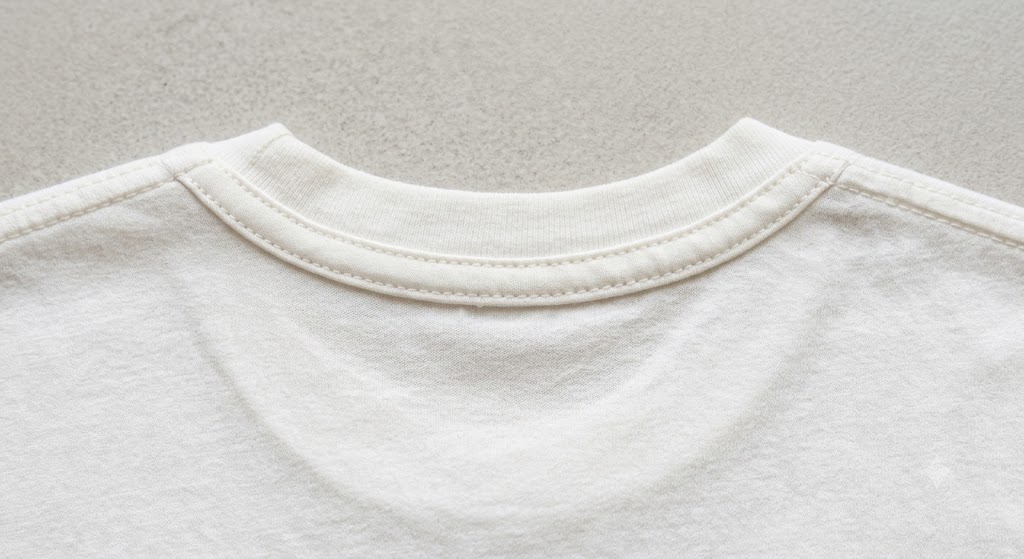
If you have ever turned a T-shirt inside out, you may have noticed a narrow strip of fabric sewn along the inside back neckline, running from shoulder seam to shoulder seam. That detail is called neck tape. It looks minor. Its effect on comfort, durability, and perceived quality is not.
What it does
Neck tape serves several functions at once, and two of them are really the same mechanism seen at different timescales: it reinforces the seam against the immediate stress of pulling a garment on and off, and it stabilises the back opening against gradual stretch deformation over repeated wear and washing — particularly important in knit fabrics, which have no inherent dimensional stability at the seam on their own. Beyond that mechanical role, it covers the raw seam allowance so the inside of the collar line feels smooth against the skin rather than rough with overlock thread, and in premium garments it doubles as a branding carrier: woven or printed labels, size indicators, care information.
There is also a dimension that has nothing to do with durability: neck tape affects how "finished" a garment looks when someone flips it inside out to inspect the construction, which matters more than its size suggests in premium knitwear where that inspection is part of how quality gets judged.
In most commercial T-shirts the tape runs shoulder-to-shoulder. In activewear and babywear it sometimes wraps fully around the neck opening as a binding. The method depends on the garment category and the quality level you are targeting.
Types and when to use them
Self-fabric tape — cut from the same jersey as the garment — is often used in higher-end knitwear for its softness and visual consistency: it matches the colour and hand exactly and behaves identically to the garment body in washing. It isn't the only route to a premium result, but it is the most cost- and labour-intensive one, since it requires cutting, folding, and feeding a narrow strip through the machine at a consistent tension.
Twill tape is a woven ribbon with a diagonal structure. It has very limited stretch compared to a knit, which makes it well suited to heavier garments like sweatshirts and hoodies where the collar line needs to hold its shape under hanger weight. The trade-off is that low-quality twill tape feels stiff against the skin. Specify a fine weave and a soft finish if you are using it in a consumer garment.
Jersey neck tape is a soft knit tape manufactured specifically for this application. It has controlled stretch and recovery, feels close to self-fabric without the cutting complexity, and is available pre-cut in standard widths. This is the most common choice for mid-market T-shirts and casual knitwear, and the easiest option to specify for a first production run.
Elastic tape — incorporating elastane or narrow elastic — is used in activewear and compression garments where the opening needs to snap back to shape after extreme stretch. It is overkill for a basic T-shirt and will feel intrusive at the neck if used in low-activity garments.
What to spec
When you write neck tape into your tech pack, specify: material (self-fabric / jersey tape / twill tape / elastic tape), width in millimetres (10 mm is the most common for a standard T-shirt; 12–15 mm for sweatshirts), colour and any branding requirements, placement (shoulder-to-shoulder vs full neck binding), and the construction method (coverstitch is standard for jersey tape; lockstitch for twill tape on woven garments).
Stretch compatibility is the most common spec error. If you specify a non-stretch twill tape on a high-stretch knit, the tape will pucker or cause the neckline to pull. This mismatch often happens when a trim gets substituted for cost or availability without anyone recalculating stretch behaviour against the fabric it is now paired with. As a rule, the tape's stretch should be equal to or slightly less than the garment fabric — enough to stabilise without restricting the opening's natural movement.
Testing before bulk
Three wash tests at 40°C before production approval. Measure the collar opening's length both before and after washing, in its relaxed state and after stretching to full extension, and compare the shrinkage rate against the body fabric — if the tape and the fabric shrink at different rates, the neckline will twist or ripple. Dry the way the end customer is likely to (tumble dry for most casualwear) so the test reflects real use rather than a best case. Check that the tape has not stiffened or changed hand feel, and check the stitching at both shoulder attachment points, which bear the most stress during washing.
Neck tape is one of those construction details that factory operators sometimes treat as interchangeable when it is really a trade-off between cost, hand feel, and stability that has to match the fabric and garment category. Specify it clearly, approve a sample before bulk, and include it in your wash test protocol. A neckline that holds its shape after fifty washes is part of what separates a garment that feels worth its price from one that does not.