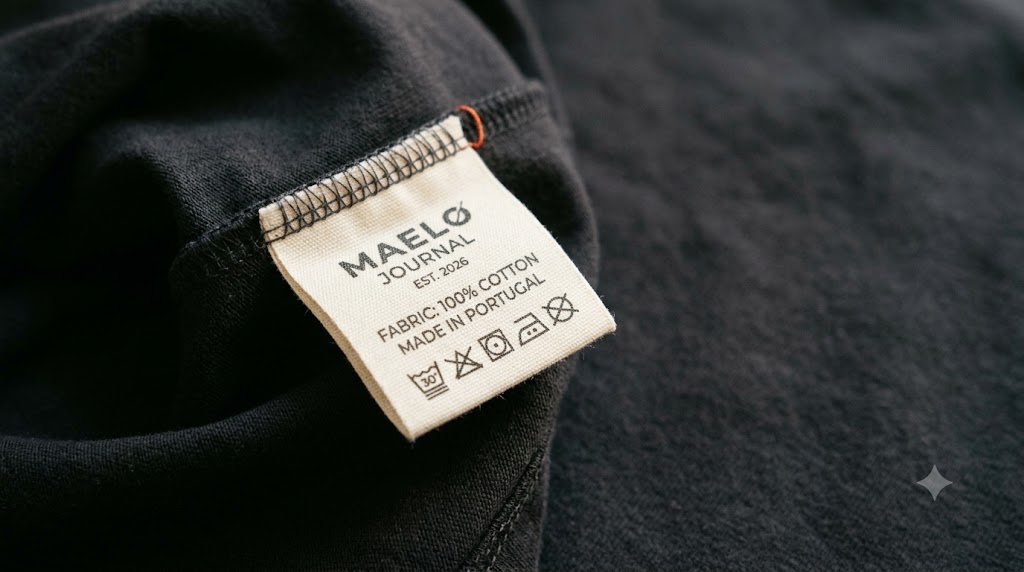
A care label is legally required in most markets. It is not decoration, and it is not optional. Getting it wrong — missing a required field, using the wrong language, printing on a material that fades after three washes — can mean customs delays, retailer rejection, or a recall. Here is what needs to be on the label, what the symbols actually mean, and how to spec it properly.
Compliance checklist
- Fibre composition (percentages in descending order)
- Country of origin
- Care symbols (ISO 3758:2012)
- Correct language(s) for each target market
- Permanently attached for the life of the garment
- Wash-fast print or weave — legible after repeated washing
- Full spec confirmed in the tech pack before sampling
What the label must contain
Fibre composition is mandatory in the EU (Textile Labelling Regulation No 1007/2011), the US (FTC Textile Fiber Products Identification Act), and most other major markets. Percentages must be listed in descending order — 100% Cotton, or 95% Cotton / 5% Elastane. If a blend has more than two fibres, list all fibres above 5%; anything below 5% can be grouped under "other fibres." The percentages are not only a legal requirement: they tell the consumer how the garment will feel, stretch, shrink, and wear over time.
Country of origin is required for imported goods in most markets. "Made in Portugal" is a statement of where the garment was cut and sewn, not where the fabric was woven. If you finish a garment in one country using fabric from another, the manufacturing country is the one that goes on the label.
Care instructions are mandatory in the EU and strongly regulated in the US. In the EU they must be present; in the US they must be accurate and follow FTC rules. In both markets, failure to provide them is a compliance issue, not just a quality gap.
Language: in the EU, the label must be readable in the official language of the country of sale. If you are distributing across multiple EU markets, use a multilingual label or rely heavily on internationally recognised care symbols — which are language-neutral by design.
The five symbol categories (ISO 3758:2012)
Care symbols are governed by ISO 3758:2012, the international standard maintained by GINETEX. Every symbol on your label should come from this system. Using invented or non-standard symbols is a compliance risk in the EU and creates confusion everywhere else.
| CATEGORY | SYMBOL | WHAT IT MEANS |
|---|---|---|
| WASHING | Number inside = max temp in °C (30 / 40 / 60 / 95). Hand in tub = handwash only. Dots below tub = mechanical action (1 = gentle, 2 = normal). ✕ = do not wash. | |
| BLEACHING | Empty triangle = any bleach permitted. Two diagonal lines = non-chlorine bleach only. ✕ = do not bleach. | |
| DRYING | Circle inside square = tumble dry; dots in circle = heat (1 dot = low 60°C, 2 = medium 80°C). Horizontal line = dry flat. Three vertical lines = drip dry. ✕ = do not tumble dry. | |
| IRONING | 1 dot = max 110°C (synthetics). 2 dots = max 150°C (wool, blends). 3 dots = max 200°C (cotton, linen). ✕ = do not iron. | |
| PROFESSIONAL CARE | P = dry clean, any solvent. F = dry clean, hydrocarbon solvent only. W = professional wet cleaning. ✕ = do not dry clean. |
Label materials and the permanently-sewn rule
In the EU and US, care labels must be permanently attached for the expected life of the garment. Glued labels do not comply. The label must also remain legible — the print or weave cannot fade, peel, or become unreadable through normal washing. This is a wash-fastness requirement on the label itself, not just the garment fabric.
| TYPE | ADVANTAGES | DISADVANTAGES | BEST FOR |
|---|---|---|---|
| SATIN | Soft, good print quality, durable, widely available | Can scratch sensitive skin | Most garment types |
| WOVEN | Symbols woven in — essentially permanent, premium look | Higher cost, longer lead time | Premium and heritage garments |
| PRINTED COTTON | Sustainable feel, natural material | Requires high print quality to survive repeated washing | Sustainable and natural-fibre garments |
| HEAT-TRANSFER | No itch, tagless comfort | Inks must be rated for 50+ wash cycles at the relevant temperature | Sportswear and basics |
What to spec in your tech pack
The care label section of your tech pack should confirm each of the following. For a full overview of what a tech pack must contain beyond the label, see A Tech Pack You'd Be Proud Of. Give the label supplier a complete written spec, not just a sketch — a label manufacturer who cannot produce a compliance checklist for your target markets is not one you want to use for your first bulk order.
- Label type (woven / satin / printed cotton / heat-transfer)
- Dimensions (width × height in mm)
- Fold style, if applicable (centre-fold, end-fold)
- Placement (back neck seam / side seam / waistband / lower inside hem)
- Attachment method (sewn all four sides / sewn at top only / heat-transfer)
- All required text content: fibre composition, country of origin, size if combined with care label
- All care symbols in sequence: washing, bleaching, drying, ironing, professional cleaning
- Required languages by target market
- QR code, if required for Digital Product Passport compliance
Common mistakes
- Wrong fibre percentages — percentages must reflect the finished garment, not the fabric as purchased. Fabric can shrink or change composition after processing.
- Missing country of origin — omitting it is a compliance failure in most import markets, regardless of how small the brand.
- Non-standard care symbols — invented or adapted symbols are not recognised under ISO 3758 and create legal exposure in the EU.
- Labels that fade — print wash-fastness is a compliance requirement, not a quality-of-life issue. Test before bulk.
- Missing multilingual requirements — distributing into France, Germany, and Spain on the same label requires all three languages, or universal symbols throughout.
- Care label not in the tech pack — if it is not specced, the factory will make a decision for you, and it may not be the right one.
What is coming: the EU Digital Product Passport
The EU's Digital Product Passport (DPP) is being introduced in phases under the Ecodesign for Sustainable Products Regulation (ESPR). Textiles are among the priority product groups, with detailed implementation timelines continuing to be defined. When it applies, brands selling into the EU will need to attach a digital identifier — most likely a QR code — to each garment, linking to a structured data record covering fibre content, country of origin, recycled content, repairability information, and care instructions. The physical label is not going away, but it will need to carry the QR code alongside the existing content. If you are building a brand that plans to sell in Europe, monitor these requirements now rather than retrofitting them into production workflows later.
Frequently asked questions
- Is a care label legally required? In the EU, US, and most major import markets, yes — fibre content, care instructions, and country of origin are all mandatory to varying degrees.
- Can I invent my own care symbols? No. Only symbols from ISO 3758:2012 should appear on garment labels. Non-standard symbols are a compliance risk in the EU and are not understood by consumers elsewhere.
- Can I print care instructions directly onto the fabric? Yes, provided the print remains legible for the expected life of the garment and meets local wash-fastness requirements. Heat-transfer labels work the same way.
- Who decides which washing instructions go on the label? The brand is responsible, usually based on fabric testing and supplier recommendations. The factory does not make this decision — it should be specced in the tech pack.
- Do I need different labels for different countries? Sometimes. Language requirements vary — the EU requires the official language of the country of sale, which may mean multiple language versions or a symbol-only label for multi-market distribution.