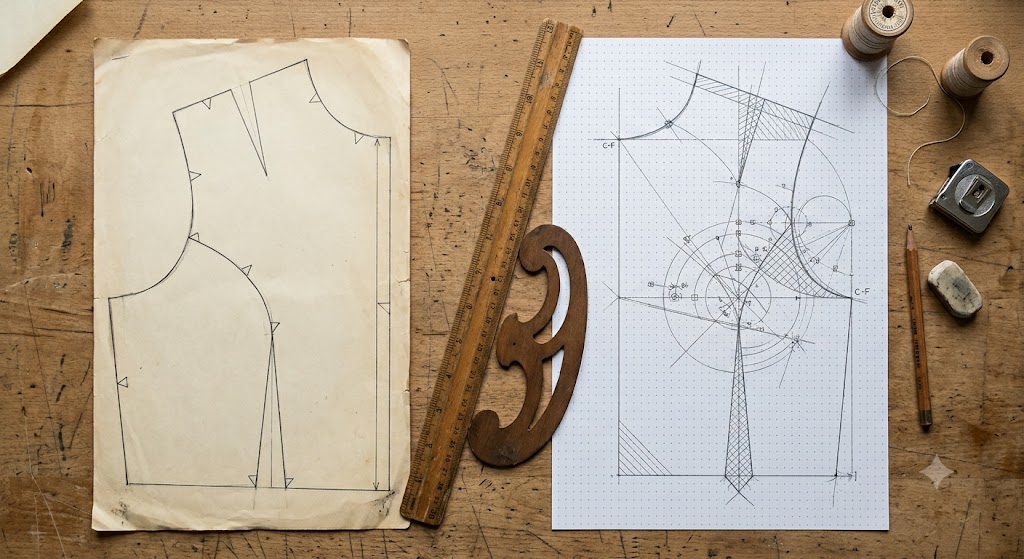
One of the first rules new pattern-makers learn is "always start from a block." It is good advice — until it isn't. A block is a tried-and-tested base pattern for a given fit category, encoding the proportions and ease values you would otherwise have to calculate from scratch. But forcing a design onto the wrong block can take longer, create more fitting problems, and produce a worse pattern than drafting from scratch would have. Here are three situations where breaking the rule saves both time and accuracy.
When the silhouette is too far from the block
If your design silhouette is dramatically different from the block — say, an extreme drop-shoulder with a very high armhole on a body block drafted with a standard set-in sleeve — you will spend more time slashing and spreading the block into the new shape than you would have spent drafting the new silhouette from measurements. As a rule of thumb: if you need to change the shoulder, armhole, and sleeve simultaneously, or you are redrawing more than half of the block's major lines, the block is no longer doing much work for you.
Take an intentionally extreme case: a drop-shoulder tee with a 30 cm shoulder extension. Getting there from a set-in sleeve block means slashing the shoulder seam, spreading it outward, and redrawing the armhole from nothing. Drafting from a chest circumference and shoulder width instead is faster and produces cleaner geometry. The block was not wrong — it just described a different garment.
When the fabric is unusual
Blocks are calibrated for a specific fabric type and weight. A jersey block assumes the fabric will stretch and recover in specific ways; a woven block assumes no stretch at all. Ease isn't just extra room — it is compensation for how a fabric bends, stretches, compresses, and hangs. Change the fabric dramatically and the geometry that produced a good fit changes with it. So when your fabric sits outside the expected category — a very open, drapey knit; a heavy, stiff canvas; a bias-cut woven — the block's ease values are wrong from the start. You'll fit it, adjust it, and fit it again, only to end up with a pattern that barely resembles the block you started from. Better to draft from scratch with ease calculations built for your actual fabric.
When the garment is structural
Outerwear with internal structure — chest canvas, shoulder pads, wadding — behaves differently from the soft shell garments that most blocks assume. The internal layers add thickness and change the fit geometry at every seam. A tailored jacket, a padded bomber, a quilted parka: none of them fit the assumptions a soft-shell block was built on. Unless you are working in a category where structured blocks already exist, drafting from scratch gives you cleaner geometry.
The hybrid approach
You do not have to choose between block and scratch. Many experienced pattern-makers draft the new pattern independently, then lay a trusted block underneath as a comparison — checking reference points like neck width, shoulder balance, bust depth, or crotch length. The comparison isn't there to dictate the design; it is there to catch a drafting mistake before it reaches a toile. If your neckline is 4 cm wider than the block's with no design reason for it, that is probably an arithmetic error, not a style choice. This hybrid approach is especially useful the first time you work in a category: the block gives you a reference point, the scratch draft gives you clean geometry.
Before reaching for a block, ask three questions: is the silhouette fundamentally different? Is the fabric behaving differently? Does the construction change the garment's geometry? If the answer is yes to any of them, drafting from measurements will likely save both time and fitting revisions. A useful heuristic: if you are redrawing roughly half of the block's major lines — shoulder, armhole, side seam, sleeve, neckline, waist — you are probably better off starting from scratch. The block is a tool, not a rule. Know when it helps you, and know when it is slowing you down.