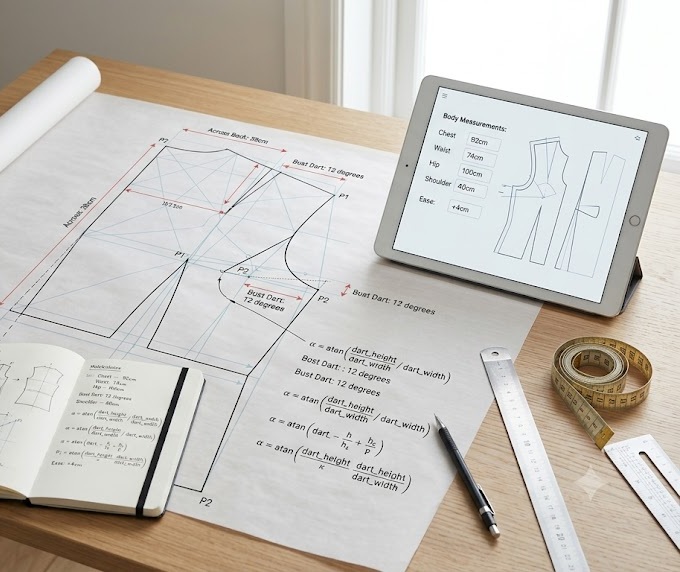
A pattern is not a drawing. It is a function. Feed it a set of measurements, and it outputs a set of pieces. Change one input — say, the chest circumference — and the whole pattern shifts accordingly. This is the core idea behind parametric pattern-making, and once you see it, you cannot unsee it.
You do not need to write code to think parametrically. A function is simply a repeatable rule: given the same inputs, it always produces the same result. A sewing pattern follows exactly the same principle — every seam, every curve, every allowance is derived from a measurement or a ratio. Parametric software makes those derivations explicit and automatic.
Traditional draping and flat-pattern methods treat each size as a separate document. You draft a size M, then you manually adjust for S and L, checking proportions by eye and correcting seams by hand. It works. But it does not scale, and it does not make the logic explicit.
Measurements as inputs
Every measurement you take — chest, waist, hip, sleeve length, shoulder width — is an argument to a function. Ease allowances are constants you set once: how much extra room should exist at the chest for movement? Typically 4–6 cm for a relaxed fit, 10–14 cm for a very oversized silhouette. These numbers are design decisions, not accidents.
The pattern piece is the output: a closed polygon whose vertices are derived from those inputs. The front body panel of a t-shirt can be described with about six measurements and three ease values. Change the chest width by 2 cm, and the side seam moves out by 1 cm per side. Change the shoulder width, and the armhole position shifts. The relationships are deterministic.
Why traditional patterns break
A pattern drawn by hand carries implicit decisions that were never written down. When you copy it to another size, you reinterpret those decisions — and each reinterpretation introduces small errors. Over five sizes, those errors accumulate. Over five seasons, they compound. The result is a pattern that no one fully understands, and that no one can confidently modify without re-fitting.
Why this matters for grading
Grading — the process of stepping a pattern up and down through sizes — is where the function model pays off most clearly. Instead of manually moving every line and curve, a parametric system recalculates the pattern using the measurements and grade rules for the new size. The relationships stay consistent because they are defined mathematically rather than visually.
Industry-standard grade rules encode the average difference between adjacent sizes for a given body region. The chest grows by roughly 4 cm between each size on a menswear block. The shoulder grows by about 1 cm. The sleeve length grows by about 0.5 cm. These rules hold across most Western menswear sizing, with minor brand-specific adjustments.
The practical takeaway
You do not need software to think parametrically. A spreadsheet with your measurements, ease values, and derived piece dimensions is a parametric pattern. When a fit comment comes back asking to lengthen the body by 2 cm, you update one cell and re-derive the affected pieces. You do not redraw everything.
The discipline is in making the relationships explicit before you start. Write down every measurement, every ease choice, every derived dimension. When the pattern changes, you will know exactly which inputs changed and which outputs followed — and you will be able to explain it to a factory in a language they can verify.