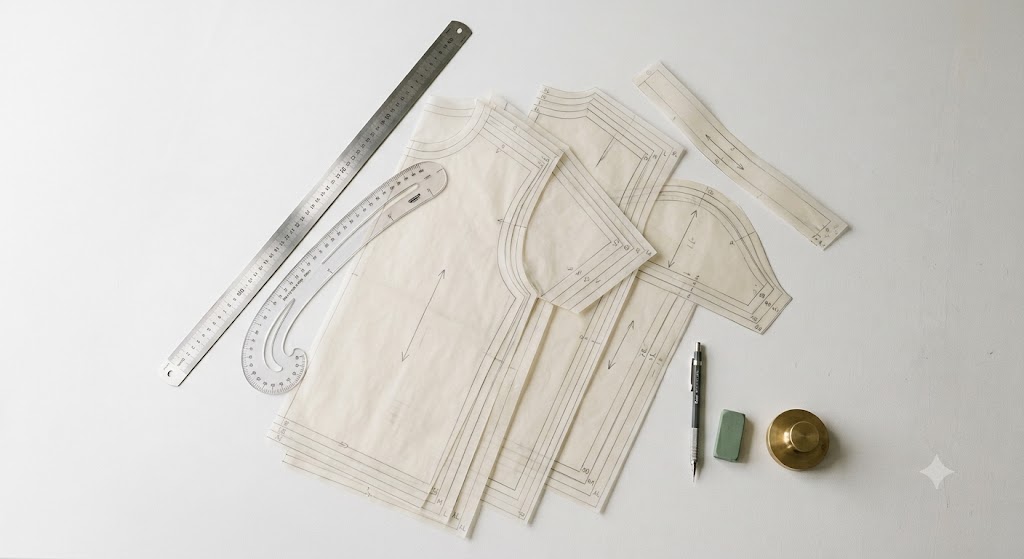
Pattern grading means creating a family of sizes from a base. The tempting shortcut — scale the base pattern proportionally — looks reasonable on paper and is almost always wrong in practice. Here is why, and what to do instead.
The problem with proportional scaling
The human body does not grow proportionally between sizes. From a size M to a size L, the chest circumference grows by roughly 4 cm. But the neck circumference grows by only about 1 cm. The shoulder width grows by about 1 cm. The sleeve length grows by about 0.5 cm. The torso length grows by about 0.5 cm. Proportional scaling would inflate all of these by the same percentage — which would make the neck opening huge, the shoulders too wide, and the sleeves too long relative to the chest growth.
Standard grade rules
Industry-standard grade rules encode these asymmetric growth patterns. For a menswear jersey garment, the typical rules per full size increment (M to L) are: Chest width +2 cm per side seam (4 cm total). Shoulder width +0.5 cm per shoulder seam. Back neck width +0.3 cm. Armhole depth +0.5 cm. Sleeve width +1 cm total. Sleeve length +0.5 cm. Body length +0.5 cm.
These numbers are starting points, not absolutes. Your brand's fit philosophy, target customer, and design language all influence where you deviate. But they are defensible starting points backed by population measurement data.
Applying the rules: a size run in numbers
Here is what those increments look like applied to a jersey crew-neck T-shirt graded from a base size M (chest 98 cm finished). The grade column shows how much each measurement changes per size step.
| MEASUREMENT | XS | S | M (BASE) | L | XL | PER STEP |
|---|---|---|---|---|---|---|
| CHEST (CM) | 90 | 94 | 98 | 102 | 106 | +4 |
| SHOULDER | 43 | 44 | 45 | 46 | 47 | +1 |
| BODY LENGTH | 67 | 67.5 | 68 | 68.5 | 69 | +0.5 |
| SLEEVE LENGTH | 57 | 57.5 | 58 | 58.5 | 59 | +0.5 |
Notice that the chest grows by 4 cm per step while the shoulder grows by only 1 cm and the body length by just 0.5 cm. Proportional scaling would widen the shoulder in step with the chest — which is why it produces a size XL that looks wide and hunched. The asymmetric increments are what keep the silhouette consistent across the run.
The base size question
Choose your base size before you start grading, and choose it deliberately. Most European menswear brands grade from a size M (chest 98 cm finished). Grading up from a smaller base is more common than grading down from a larger one, because fit problems tend to accumulate as you grade up — you want to fit-approve at your base before committing to the full size run.
A well-graded pattern is one where every size looks like it was drafted independently. If the S looks like a shrunken M, the grade is too proportional. The test is to put all sizes on the same form and check that proportions hold across the range.
The visual check
After grading, stack the outlines on a lightbox or trace them together on the same sheet. Every grade line — the seam connecting adjacent sizes at each construction point — should be smooth and continuous, with no abrupt kinks. A kink in a grade line means one measurement was graded at the wrong increment, or the correction was applied to the wrong vertex on the seam. Redraw the grade line as a smooth curve through the correct points and work backwards to find the error. See also Why Every Pattern Is a Function for how parametric drafting keeps these relationships explicit from the start.